


CMB Lensing
The large scale structure in the universe deflects the cosmic microwave background photons. The typical deflection is a couple of arcminutes, but the deflection field is coherent over a large range angular scales, up to about a few degrees. The deflections smooth acoustic features in the primary cmb anisotropy, moves power from large scales in the CMB to the damping tail and generates non-Gaussianity. I study the effect and its implications to cosmology both analytically and through numerical simulations.
We recently detected for the first time the lensing effect using CMB data alone, S. Das et al., Phys. Rev. Lett 107, 021301 (2011):

Using this detection, we demonstrated for the first time that dark energy is required by CMB data alone, B. D. Sherwin et al., Phys. Rev. Lett. 107, 021302 (2011) :
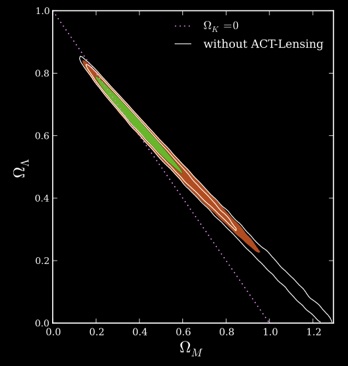
Previously we also found a ~3 sigma hint of lensing in our power spectrum measurements, using the smearing effect on acoustic peaks:

Fig. Detection of Lensing ( Das et al. 2010)
I also intend to look for this effect directly in the ACT maps.
Small scale CMB Experiments - Secondary Anisotropies
The next generation CMB experiments will probe the high multipole (l>1000) range of the CMB anisotropies, where the so-called secondary anisotropies, produced by the interaction of the CMB photons with the structure in the late universe, are the dominant effect. These secondary anisotropies will be nuisance for getting at the primordial properties of the universe, but they will be interesting in their own right as probes of late time cosmology and astrophysics. I am involved in one such experiment, the Atacama Cosmology Telescope (ACT).
CMB Power Spectrum Estimation
With Amir Hajian and David Spergel, I have proposed a new method for estimating the power spectrum of high resolution CMB maps. At the resolutions of ACT and the South Pole Telescope (SPT) the CMB maps will be contaminated with a large number of point sources which need to be masked. Such masking and also hard edges lead to aliasing of power, so that the mode-coupled power spectrum is highly biased at high multipoles. This bias leads to large error bars on the final power spectrum when standard decorrelation techniques are used. We came up with a real space operation called pre-whitening which effective reduced aliasing of power. Also, we generalized a technique, usually used in signal processing and known as the Adaptive Multitaper Method (AMTM) to two dimensions to deal with aliasing due to hard edges. With these methods, we showed that at multipoles above 2000 we were able to reduce the error bars over the standard methods by a large factor.
Currently, I am involved in measuring the CMB power spectrum for ACT.

We recently put out a power spectrum measurement from ACT, which clearly shows the higher order acoustic peaks of the CMB.

Fig: Power spectrum measurement from ACT plotted with l^4 scaling to emphasize the higher order acoustic peaks of the CMB (Das et al. 2010) .
Statistical Gravitational Lensing
With Professor Jeremiah P. Ostriker, I have investigated how the probability of strong lensing of a distant source by intervening structure depends on the cosmology. We came up with a way to analytically generate the probability density function of the dark matter convergence from a given input cosmology. The results have been published in the astrophysical journal, 645, 1 (2006).
